
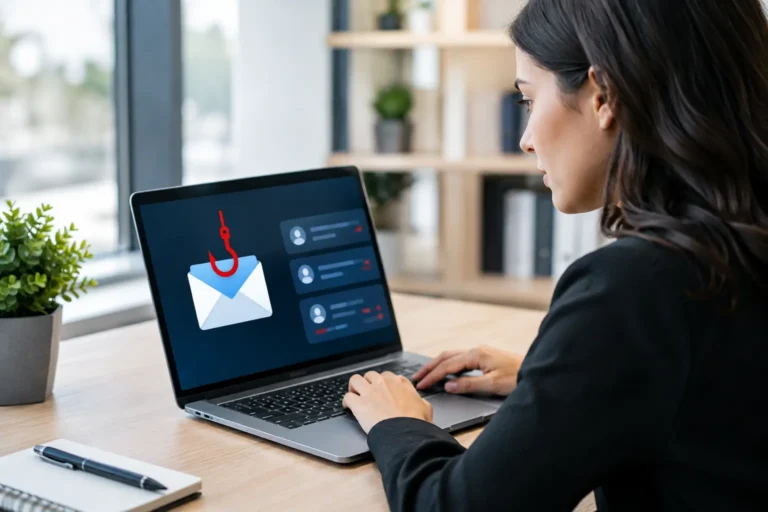
A finance officer receives an email that appears to be from a regular supplier. The logo is familiar, the invoice amount is plausible, and the sender asks for an updated bank account to be used before the next payment run. This is the kind of moment where a single decision can create financial loss, disclosure of sensitive information, or an entry point for a broader compromise.
Phishing simulation services help organisations prepare for that moment before a genuine attacker creates it. Done well, they are not a test of who can be caught out. They are a practical way to understand how people, business processes and technical controls respond to realistic social engineering attempts.
For Australian organisations managing sensitive customer data, government information, financial transactions or critical operations, phishing resilience is a business continuity issue. A simulation programme should provide evidence for better decisions, reinforce positive reporting behaviour, and identify where targeted security improvements will reduce real-world risk.
What phishing simulation services should achieve
A phishing simulation is a controlled campaign that sends realistic but safe emails, messages or other social engineering scenarios to an agreed group of users. The service records defined actions, such as opening an email, following a link, submitting a simulated credential, reporting the message, or ignoring it.
Those results matter, but they are only the starting point. A meaningful programme examines why a scenario succeeded. Was the email delivered despite mail security controls? Did its content exploit a business process that staff use every day? Was the reporting button difficult to find? Did a user know something was suspicious but lack confidence about escalating it?
The strongest phishing simulation services turn those observations into a cycle of improvement. This can include focused awareness training, changes to email protection, clearer payment-verification processes, conditional access improvements, multi-factor authentication uplift, and tested incident response procedures.
The objective is not a lower click rate for a board report. It is an organisation where staff pause, verify unusual requests and report suspected phishing quickly enough for the security or IT team to contain a genuine campaign.
Simulations should reflect your actual risk
Generic phishing templates can be useful for baseline awareness, but they have limits. A health provider faces different lures from a construction business. A local council may need to account for public-facing services and high volumes of correspondence, while a professional services firm may be exposed to invoice fraud, document-sharing requests and credential theft.
A tailored programme considers the organisation’s systems, terminology, approval workflows, supplier relationships and threat profile. It may test a fake Microsoft 365 sign-in request, an overdue invoice, a shared-document notification, an executive impersonation attempt, or a QR-code lure. The scenario must be credible enough to assess behaviour without unnecessarily disrupting work or causing distress.
Timing also matters. Running a simulation during a major payroll cycle, emergency response, system migration or peak service period may produce misleading results and place undue pressure on staff. A capable provider plans campaigns around operational realities, with agreed safeguards and escalation paths.
How a phishing simulation programme is delivered
Phishing testing is most valuable when it is treated as an ongoing security control rather than a once-a-year compliance activity. Threat actors adapt their methods, organisations change their technology, and staff turnover alters the risk profile. Regular, measured testing gives leaders a clearer view of whether security behaviours are improving.
A well-managed engagement generally begins with discovery. The provider works with technology, risk, HR and leadership stakeholders to understand the organisation’s objectives, workforce structure, existing awareness activity, mail environment and relevant obligations. This also establishes who should be included, excluded or handled differently, such as contractors, frontline personnel, executives or shared-mailbox users.
Next comes campaign design. The scope should document approved scenarios, communication protocols, data handling requirements, success measures and the process for pausing a campaign if an unexpected issue occurs. For organisations with mature security operations, simulations can also validate whether alerts, user reports and incident triage processes work as intended.
The campaign itself should be safely controlled. No real credentials should be collected or retained, and landing pages should not expose users to malware or unsafe content. The exercise should use the minimum data required to deliver useful findings. This is particularly relevant for regulated sectors and organisations with strong privacy, workplace relations or union considerations.
Following the campaign, the provider should analyse outcomes with context. A department with a higher interaction rate may have received a more complex scenario, operate under time pressure, or rely on a process that warrants additional controls. Reporting should avoid turning results into a public scoreboard. Individual follow-up is best handled respectfully and, where appropriate, through existing people-management processes.
Finally, the programme should produce practical remediation. That may be a short learning module for a targeted group, a refreshed process for confirming bank detail changes, improved email banners, better reporting instructions, or technical work to strengthen Microsoft 365 protections. Sentaris can connect these findings with broader security assessments, security engineering and assurance work, so the response addresses the conditions that made the lure effective.
Measures that show genuine improvement
Click rates are easy to understand, but relying on them alone can create the wrong incentives. If staff fear being blamed, they may avoid reporting suspicious messages or rush through training simply to meet a requirement. Both outcomes reduce visibility when it matters most.
A balanced measurement approach looks at several indicators together:
- reporting rate and the time taken to report suspected phishing;
- interaction rates across different scenario types and business groups;
- simulated credential submissions, assessed as a higher-risk outcome;
- the performance of mail filtering, endpoint controls and security monitoring; and
- trends over multiple campaigns, rather than a single result.
Reporting is often the most valuable measure. A person who reports a suspicious message has given the organisation an opportunity to remove similar emails, investigate sender activity and warn other users. Encouraging that action builds a human detection capability that technical tools alone cannot provide.
It is also worth separating educational simulations from advanced assurance exercises. Most organisations benefit from routine awareness-focused campaigns that use clear, safe scenarios and immediate feedback. Higher-risk simulations, such as executive impersonation or credential-harvesting exercises, may be appropriate where leadership has approved the scope, controls and support arrangements. These exercises should be proportionate to the organisation’s maturity and risk appetite.
Connecting people, process and technical controls
A user who recognises a phishing email is valuable. A user who can report it in one or two clicks is more valuable. A security team that receives the report, investigates quickly and blocks the campaign across the environment provides the resilience that organisations need.
That is why phishing simulation findings should feed into a wider cyber security programme. Mapping improvements against the Essential Eight, CIS Controls, NIST Cybersecurity Framework or NIST 800-53 can help leaders demonstrate that awareness activity supports recognised control objectives. It also prevents training from being treated as a standalone answer to problems that require technical or procedural change.
For example, a simulation involving a fake shared-document invitation may reveal that staff need more guidance on external sharing. It may also indicate a need to review tenant configuration, email authentication, safe-link protections, conditional access policies and the process for reporting suspicious messages. The appropriate response depends on the evidence, not on a pre-set product or training package.
Executive teams should receive clear, decision-ready reporting: the scenarios tested, observed behaviours, control gaps, risk implications and prioritised actions. Technical teams need sufficient detail to implement changes. Staff need practical feedback that respects their role in protecting the organisation. Each audience requires a different level of detail, but all should understand how their actions contribute to resilience.
Choosing a provider for phishing simulation services
When assessing phishing simulation services, ask whether the provider can do more than run email campaigns. They should be able to design scenarios around your risk, work respectfully with internal stakeholders, protect employee data, interpret results fairly and assist with remediation.
Independence also has value. An experienced external team can challenge assumptions about controls and processes while working collaboratively with internal IT and security teams. For organisations without a dedicated security function, the provider should explain findings in plain language and offer a practical path from identified risk to implemented improvement.
A phishing simulation should leave the organisation better prepared, not simply better informed about a score. When staff know how to recognise, verify and report suspicious activity, each simulated email becomes a useful rehearsal for protecting the real business.